
Shaping product direction
Defining where AI could improve product selection.
I grounded AI exploration in user research, focusing the team on needs that structured filters couldn’t meet. The resulting concept let advertisers describe nuanced product requirements in natural language.
The challenge
Coming up with promising AI concepts.
FMCG advertisers use retailers’ (e.g. Walmart) purchase data to better understand and reach consumers based on what they actually buy. To request this data, advertisers first need to specify which products they’re interested in by searching the retailer’s often vast product catalog and creating a list of relevant products. Finding and selecting the right products is therefore a critical first step in using retail data for advertising.
Our existing product supported two ways of selecting products. Structured requirements that mapped cleanly to product data (such as brand, category or price) could be defined using filters, allowing the resulting product list to update dynamically as the catalog changed. More nuanced requirements, such as products relevant to a “back-to-school” promotion, required users to manually search for and add individual products.
Our product team was approached by Data Science to explore how AI could improve product selection.
My role
As Senior Manager, UX Design for the product team, I led the UX work for this initiative, with a particular focus on turning the AI concept into an experience that users could understand, use, and come to trust.
Given the strategic importance of this work to the company’s broader AI efforts and the relative newness of these interaction patterns, I worked closely with a junior designer on my team and our developers to define the experience, then iteratively validate and refine it through user testing.
Contribution 01
Grounding explorations in validated user research.
Before brainstorming, I reviewed existing user research conducted by my team and refreshed the product team on key insights, ensuring our exploration was grounded in validated user needs rather than AI capabilities.
Some of these insights included:
Advertisers could be working with catalogs containing millions of products, and were often unfamiliar with how retailers structured and categorised them.
While accuracy and completeness mattered in certain scenarios, speed was often more important in encouraging advertisers to use retail data in the first place.
More importantly, advertisers thought in terms of product characteristics and business intent (such as products relevant to a “back-to-school” campaign) rather than specific products or SKUs.
Contribution 02
Defining criteria to evaluate ideas.
Given the cost of fully developing and testing concepts, I made it clear to the product team that we would only invest in fully exploring ideas that demonstrated meaningful user value. This also helped keep the exploration focused on solving real user problems rather than applying AI for its own sake.
The guiding principle was simple – a new solution needed to provide enough value to justify asking users to learn or change their existing way of working.
Ideas we prioritised therefore needed to (1) avoid introducing unnecessary steps or complexity (2) solve a new or unmet user need (3) significantly improve an existing experience to justify relearning.
Contribution 03
Brainstorming and developing concepts.
I played a key role in brainstorming and fleshing out potential concepts for the team. Some of the ideas we explored included:
AI-generated starting lists: Users describe the product list they want to create, and AI generates an initial set of proposed products ranked by relevance.
AI-powered recommendations: AI reviews products already selected by the user and suggests products that may have been missed.
These ideas did not meet our criteria, as they introduced unnecessary steps or complexity to the workflow without providing enough demonstrable user value.
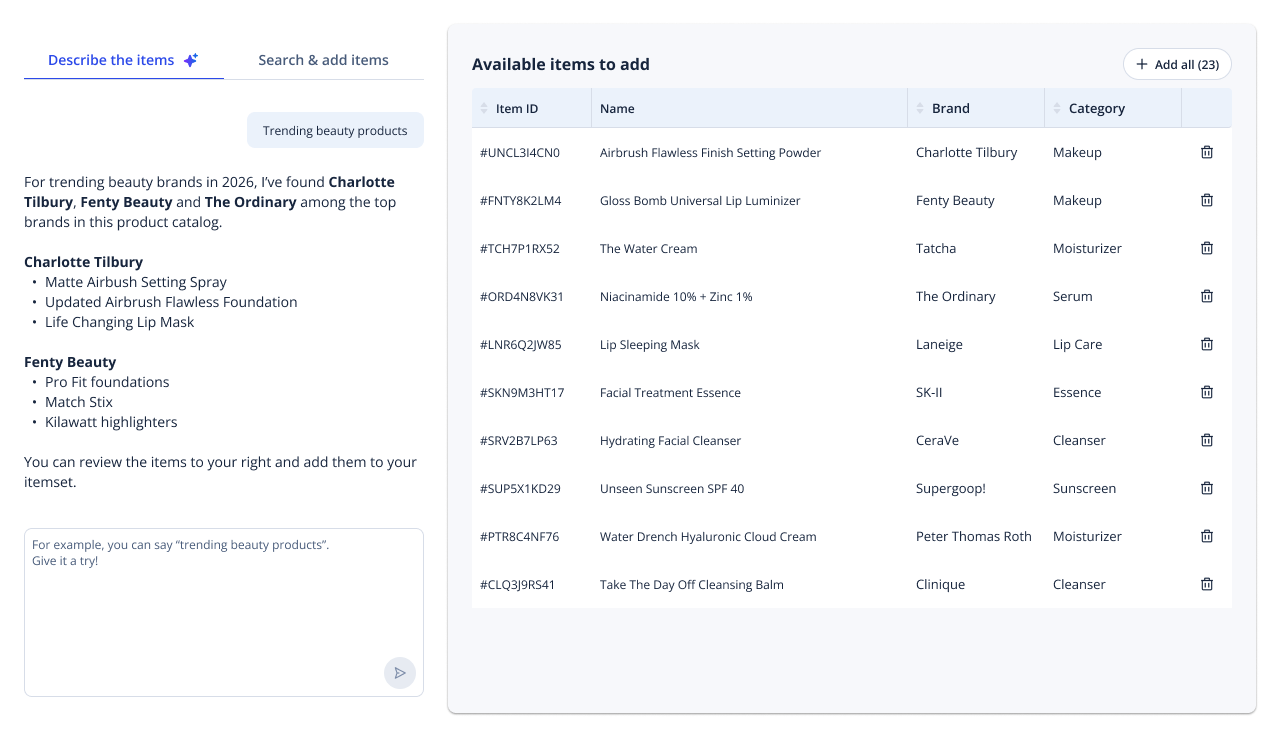
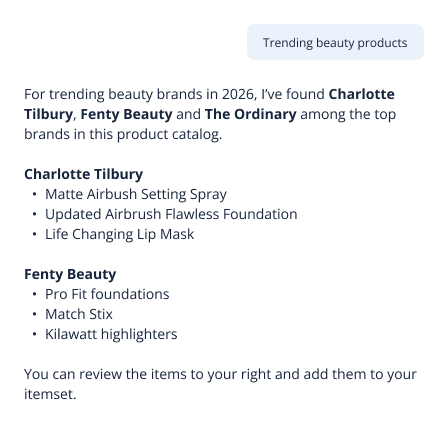
I guided the team to focus instead on using AI for nuanced requirements that could not be easily expressed through structured filters. For example, AI could translate a concept like “trending beauty products” into relevant product characteristics, then use these to identify matching products from the retailer’s catalog.
Importantly, we did not use AI for simple, filter-based requirements. Structured filters already worked well here, while introducing AI’s probabilistic behaviour could actually make the results less predictable and precise.
Contribution 04
Making the direction tangible.
Once we had identified a worthwhile direction, I developed high-level concept mocks and a prototype to fully illustrate how the idea could work. These helped align the product team around a common vision, gave engineers enough detail to understand what needed to be built, and helped secure product leadership buy-in.
With leadership commitment and resourcing, the project moved from exploration into development of a working prototype for user testing — turning an open-ended AI exploration into a defined product direction that the team was ready to invest in.
See part 2 of the case study on defining the interaction patterns for this feature here.

