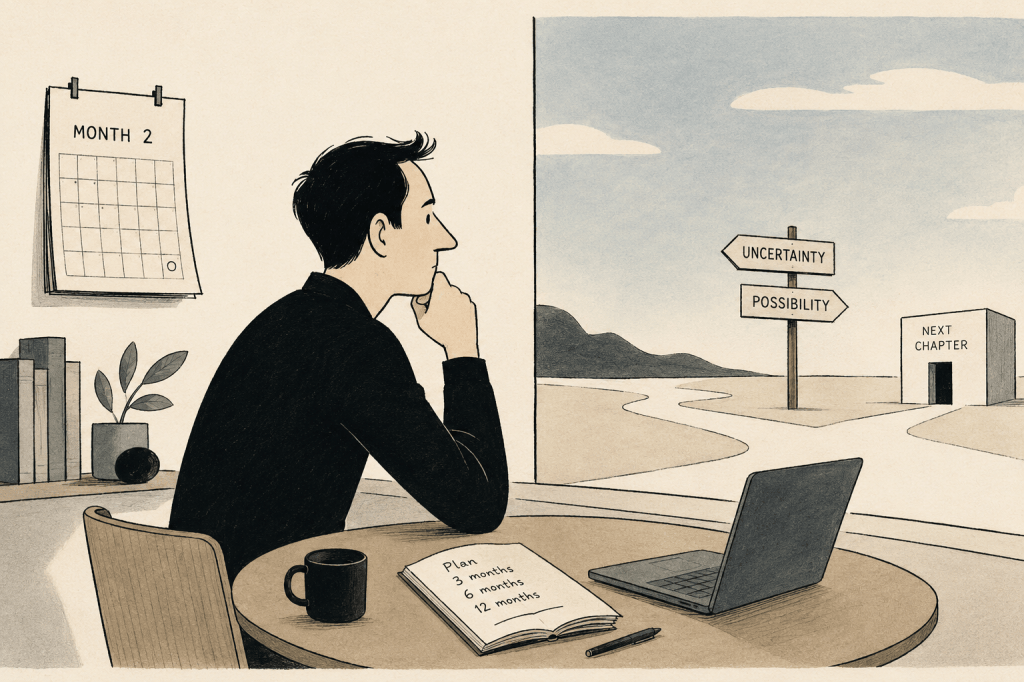
So it’s been nearly two months of being officially unemployed.
I’ve noticed myself using euphemisms like “funemployment” or “taking a break” when friends ask how I’m doing.
Pride, perhaps?
I suspect it’s more to soften the anxiety I feel about the whole thing though. “I’m taking a break” suggests agency and intent, whereas “I’m unemployed” admits uncertainty and lack of control.
It’s just two months, Frank.
Objectively speaking, two months isn’t long – friends have told me this, recruiters have told me this, hell, I’ve told myself this. I’m also cognisant, and very thankful that I’m resting on decent financial runway for now.
Yet my nervous system appears to not have received either memo.
And some days just hit hard. I wake up. Check my email. Nothing. No rejection, even. Just nothing.
There’s no progress bar for unemployment.
Security blanket or rag?
There’s something incredibly uncomfortable about being in a prolonged state of uncertainty, no matter the buffers or assurances.
We all cope better when we feel we have some control over what happens next, and a job provides an astonishing amount of that. It gives structure and tempo to our daily lives. There are tasks to do tomorrow, a salary at the end of the month, and a sense of where our career is heading.
It’s a proverbial security blanket.
So when the job disappears, we are forced to confront the uncomfortable reality of just how easily this blanket can come apart. The salary is gone. Our career trajectory becomes less certain. Our daily structure disappears. Our professional identity gets weird and we start questioning past choices. Even our savings, which may not have changed that much after two months, suddenly feel very different because there’s no predictable stream replenishing them.
Maybe the blanket was always just a rag, but we needed to believe it’s more substantial than it really was. Because constantly confronting how easily our jobs, finances, health or best-laid plans can unravel would be a fairly exhausting and miserable way to live. Unemployment denies us that luxury and forces us to look directly at the uncertainty that was there all along.
Putting life on hold
But what’s causing the discomfort isn’t just about having to confront this uncertainty.
I’m more worried that I’ll fill the coming days with so much fear and anxiety that I’ll fail to actually live happily and meaningfully. That I’ll treat life as temporarily on hold, with the main objective being to get out of this period as quickly as possible. Everything else then becomes something to fill the hours until “real life” resumes.
I really don’t want that.
The challenge of a liminal period isn’t merely getting through it. It’s also about not being so obsessed with escaping it that you fail to live in it.
A plan of attack for myself
I don’t know how to do this well yet. I don’t know how much job hunting is enough, or how successfully anyone can really compartmentalise the waiting. But I’m telling myself to try a few things:
Give uncertainty some boundaries
Know my financial runway. Plan for 3, 6, 12 months of unemployment. Decide in advance what changes at each point: how I approach my finances, when I widen my job search, when I reconsider the plan entirely. Then almost wilfully put on horse blinders and focus on living within those time boundaries.
Explore things that might make me less fragile
Use the time within these boundaries to take my side projects more seriously. Not necessarily because they need to become businesses, but because now’s one of the rare periods in my adult life where I have the time to follow through on something I find interesting and see where it goes. Maybe something turns into more than I expected. Maybe I develop a completely new skill. Maybe it simply becomes something I care about. I don’t want to treat these projects as filler while I wait for my employment to resume.
Set effort-based goals
Set small achievable, effort-based goals for these side projects. Because when something important in life seemingly has no visible progress, things with visible, tangible outputs become particularly valuable. So plan a workout schedule. Set goals for writing, learning stuff, cooking. Then create a loose structure around my weeks to attack these goals.
Allow my bad days to be bad days
A rejection hurts. Silence hurts. Not every response needs to be heroic or strong. Not every moment needs to become a lesson in resilience (or an inspiration for a blog post).
One technique I’ve quickly grown to appreciate is to just go out for an aimless walk. Somehow the act of moving soothes the soul immensely. And maybe it’s related to finding activities that genuinely feel like self-care, even on days when part of me thinks I should be doing something more “productive.”
Final thoughts
I don’t know whether I’ll look back at this period as a wonderful sabbatical in which I rediscovered myself. That feels a little optimistic at this moment.
For now, I’m pretty sure there will be mornings where I check my email and the silence gets to me. But what I definitely don’t want is to spend this entire period waiting for my life to restart.
I hope to come out the other side a little less fragile, having spent my time well.
Wish me luck!
And yeah, if you know of companies that need expertise related to UX design, problem reframing and innovation – ping me. I’d love to have a chat!


Leave a comment