
Senior Manager, UX Design | The Trade Desk
Overview
As The Trade Desk expanded support for new creative types, ad formats, publishers and data providers, creative-related issues became increasingly difficult for advertisers to manage.
Publisher-specific requirements, retailer restrictions, upload errors, asset defects, and bidding constraints all generated different issue types. The team’s initial instinct was to identify every possible error scenario and design individual alerts for each.
I believed this approach would not scale.
Instead of designing for hundreds of individual issue types, I led the development of a framework that allowed Product, Design, and Engineering teams to consistently classify new issues and derive appropriate responses.
The resulting framework shaped how issues were prevented, prioritized, surfaced, and resolved across the platform.
The Challenge
Creative issues originated from many different sources:
- Incorrect user inputs during upload
- Creative asset defects requiring agency intervention
- Publisher-specific requirements (e.g. streaming platforms)
- Retail media restrictions tied to audience selection
- Runtime failures discovered during or after campaign execution
As the number of issue types grew, so did complexity.
At the same time, user research revealed an important insight:
Traders do not think in creative issues.
They think in campaign outcomes.
When troubleshooting campaigns, users were primarily concerned with:
- Can my campaign spend?
- Can it reach enough users?
- Am I reaching the right users?
- Are creative issues limiting delivery?
Creative issues were rarely the primary workflow.
They were exception workflows.
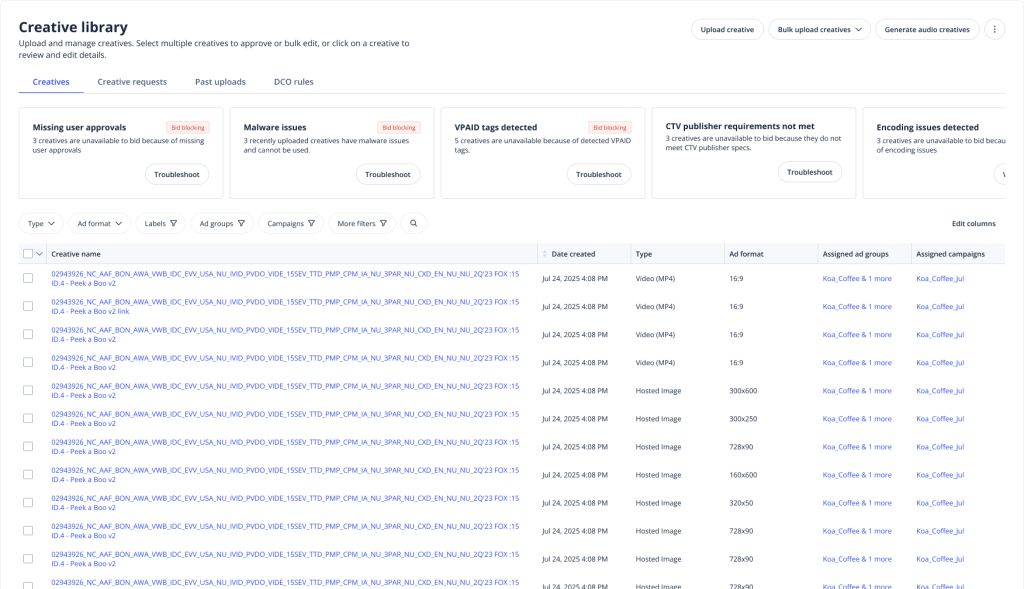
Yet the existing experience surfaced issue categories prominently, forcing users to interpret technical problems before understanding their impact.
This created a tension:
- Too many alerts created noise and alert fatigue.
- Too little visibility led to campaign delivery problems.
The challenge became helping users focus on what mattered without overwhelming them.
Reframing The Problem
The team initially approached the problem as an enumeration exercise: identify every issue type and design corresponding alerts.
I advocated for a classification framework instead, allowing future issue types to inherit handling patterns without requiring bespoke solutions.
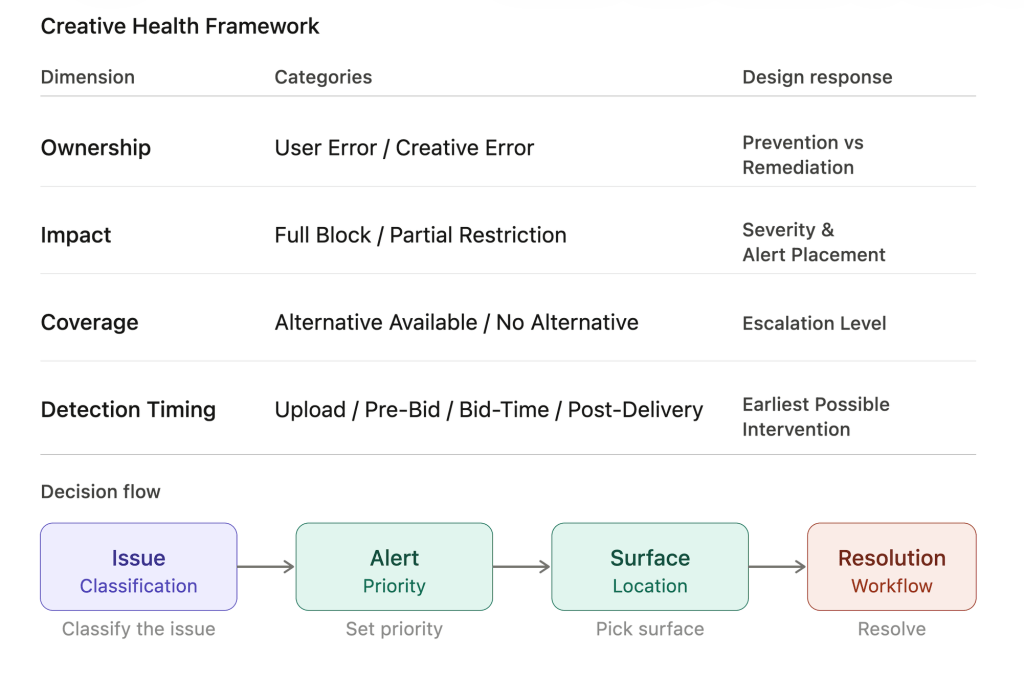
Rather than asking what alert we should prioritise to design, we began asking:
- Who can resolve this issue?
- How much delivery does it impact?
- Is there an alternative available?
- How early can we detect it?
These dimensions then determined:
- Alert priority
- Surface location
- Resolution workflows
- Engineering implementation patterns
Applying The Framework
1. Shift Detection Earlier
One of the clearest opportunities was reducing issues before campaigns launched.
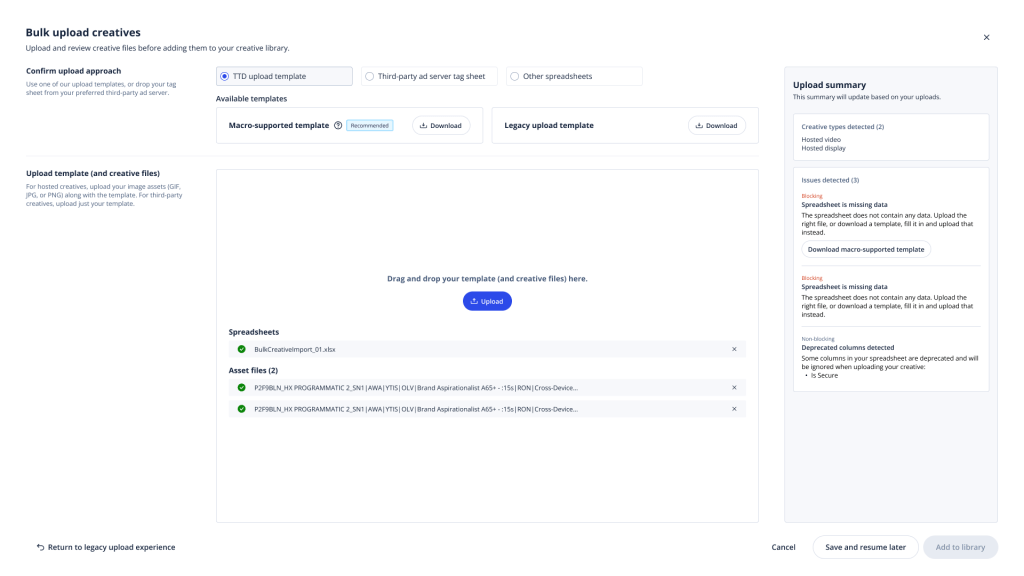
Many user-generated problems originated from confusing upload templates and upload workflows.
Working with Product and Engineering, we redesigned bulk upload experiences and introduced validation during upload.
Issues that previously surfaced during campaign execution could now be detected and resolved immediately.
Outcomes
- Reduced user-generated errors
- Earlier issue detection
- Lower troubleshooting burden downstream
2. Prioritize Alerts Based on Impact
Research showed users did not care about issue categories.
They cared about consequences.
The original experience emphasized issue types such as:
- Malware detected
- VPAID tags missing
- Publisher requirements unmet
- Encoding errors
These categories reflected system implementation details rather than user goals.
Using the framework, we shifted toward impact-driven prioritization.
The severity and visibility of alerts were determined by:
- Delivery impact
- Availability of alternatives
- Ability to resolve
This helped reduce noise while ensuring critical issues received attention.
3. Surface Issues Where They Matter
Not all issues deserved the same level of visibility.
The framework informed a hierarchy of alert surfaces:
Campaign/Ad group Summary Level
For issues leading to creatives being blocked in current context with no alternatives.

Campaign/Ad group Creative Summary Level
For the above-mentioned issues and issues leading to creatives blocked in current context.
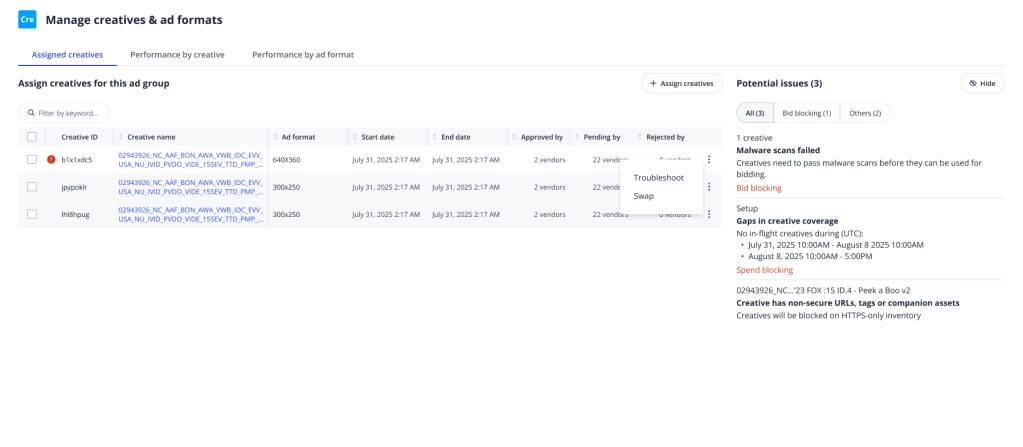
Individual Creative Level
For the above-mentioned issues and all other issues detected.

This ensured users received information at the appropriate level of context.
4. Improve Resolution Workflows
The framework also exposed gaps in remediation.
For creative-related issues, user research and workflow analysis revealed traders frequently performed repetitive unassign-and-reassign actions when replacing creatives.
I partnered with Product and Engineering to advocate for creative replacement workflows that reduced operational effort and accelerated issue resolution.
Rather than simply identifying problems, we focused on helping users recover from them.
Impact
The Creative Health Framework became a shared model used across Product, Design, and Engineering teams.
Rather than designing bespoke solutions for each new issue type, teams could classify issues and apply consistent response patterns.
The work resulted in:
- Simplified creative troubleshooting experiences
- Earlier detection of creative issues
- Reduced operational overhead for advertisers
- More consistent alerting across workflows
- Faster implementation of future issue types
Creative management and troubleshooting ultimately became one of the highest-rated workflow areas within the platform.
Reflection
The most valuable lesson from this project was that the problem was never alerts.
The real challenge was helping users focus on what mattered.
By shifting from issue enumeration to a scalable classification framework, we created a foundation that allowed teams to consistently prevent, prioritize, surface, and resolve creative issues as the platform continued to evolve.
The framework ultimately became more valuable than any individual screen because it enabled future product decisions to scale alongside the business.
 Frank Chen
Leave a comment