
Senior Manager, UX Design | The Trade Desk
The Ask
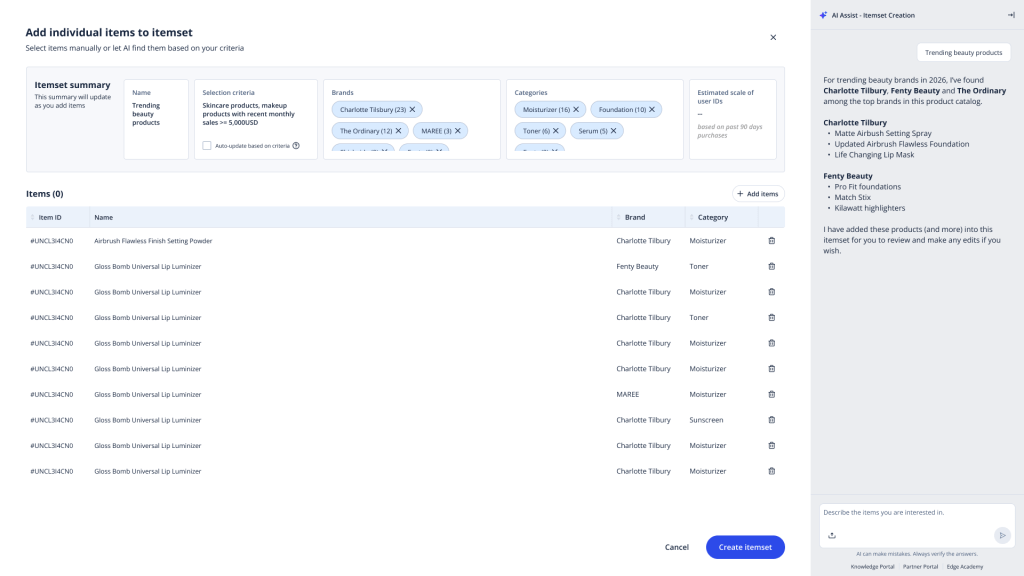
Enable advertisers to efficiently create and maintain itemsets from large retailer catalogues, reducing friction in adopting retail data for campaign planning, targeting and measurement.
As retail data became a growing strategic focus for The Trade Desk, reducing the effort required to build and maintain itemsets became increasingly important to driving adoption.
Background
Itemsets are collections of retailer products that are then used in campaign workflows, including segment/audience creation, targeting and measurement.
The existing itemset builder required users to manually browse and select products from retailer catalogues. While conceptually straightforward, the approach struggled to scale.
Some retailer catalogues contained millions of products, making the experience slow to load and difficult to navigate. Traders often completed the task over multiple sittings or rushed through the workflow entirely.
This created several challenges:
- Long loading times and poor performance
- Difficulty finding relevant products
- Incomplete item sets due to missed product variants
- Low confidence that created segments accurately reflected campaign intent
The result was a workflow that became increasingly difficult to manage as The Trade Desk onboarded newer retailers with larger catalogues.
Research
Through user research, I discovered something important: The traders creating itemsets were rarely the people who created or maintained retailer product catalogues. As a result, they were often unfamiliar with individual products and SKUs.
Instead, users thought in terms of attributes such as:
- Brand
- Category
- Product characteristics
- Seasonal relevance
They did not think in individual products.
This became the key insight that guided the redesign.
The problem was not selecting products.
It was to translate business intent into products.
Phase 1: Criteria-Based Item Sets
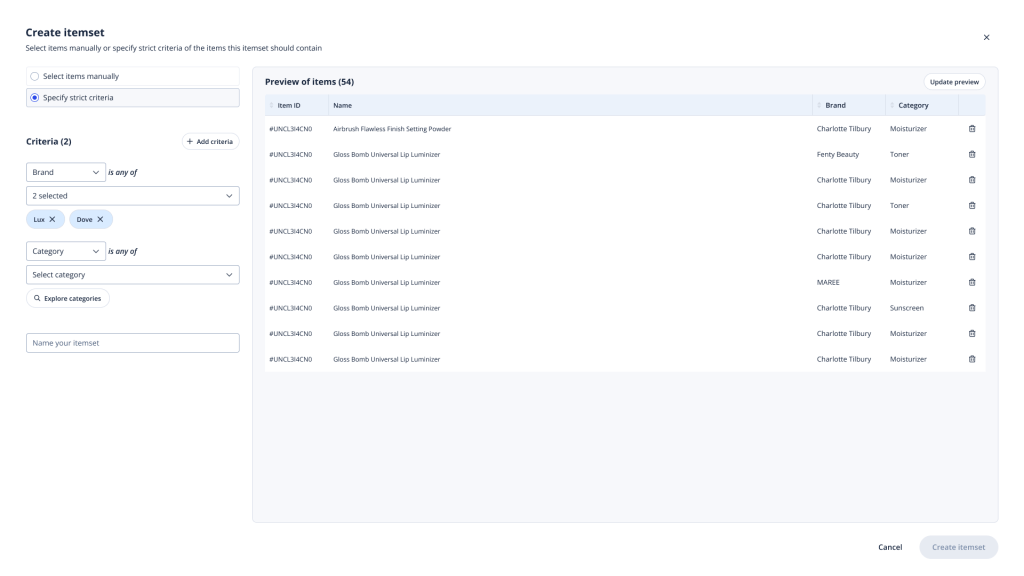
Rather than forcing users to manually select products, I proposed allowing itemsets to be defined through product attributes.
Users could create item sets using combinations of criteria such as:
- Brand
- Category
- Product attributes
The system would then automatically assemble and maintain the matching products.
This shift delivered several benefits:
- Improved performance and scalability
- Reduced manual effort
- Lower risk of omitted products
- Dynamic item sets that automatically updated when retailer catalogues changed
Most importantly, it aligned the workflow with how users actually thought.
Instead of:
“Find every Dove moisturiser.”
Users could simply define:
Brand = Dove
Category = Moisturiser
and allow the system to assemble the underlying products automatically.
By reducing the effort required to create and maintain item sets, the redesign removed one of the largest barriers to activating retail data. Traders could experiment with retail audiences more confidently, accelerating adoption of retail capabilities across campaigns.
Why We Initially Said No to AI
Several months after launch, Data Science began exploring opportunities to introduce AI capabilities into enterprise workflows.
I was initially cautious – many AI initiatives at the time were being driven by technological possibility rather than user need.
My position was simple:
AI should only be introduced if it either solved a new problem users genuinely cared about or delivered a significant improvement over an existing workflow.
Feature parity alone would not justify the adoption cost of changing established enterprise workflows.
Phase 2: Intent-Based Item Set Creation
As we explored opportunities with Data Science, I realised there was still a class of item sets that remained difficult to express through structured criteria alone.
Examples included:
- Trending beauty products
- Emerging product categories
- Seasonal product collections
- Products similar to a competitor’s offering
These concepts relied on contextual understanding that traditional filtering could not easily represent.
This led to a new question:
If users already thought in concepts and intent, could they simply describe what they wanted and allow AI to assemble the underlying item set?
Designing the AI Workflow
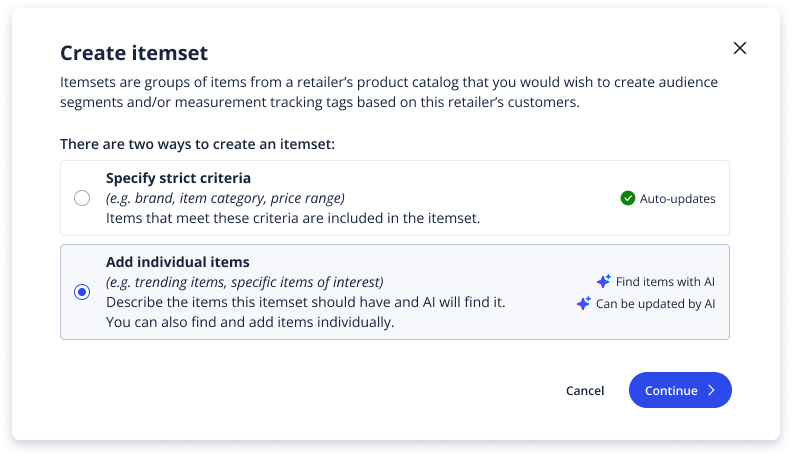
Our team became one of the first groups at The Trade Desk to introduce AI-powered workflows.
Because we were among the earliest teams exploring AI, we helped establish many of the foundational interaction patterns that would later influence AI experiences across the platform.
AI was not a separate mode
One of the most important decisions was ensuring AI remained integrated with existing workflows.
Users could:
- Generate item sets using prompts
- Refine results manually
- Add or remove products directly
- Move seamlessly between AI-assisted and manual workflows
Rather than creating a dedicated “AI mode”, AI became a layer on top of an existing workflow. This made the capability more flexible, trustworthy and easier to adopt.
Knowing when not to use AI
We also recognised situations where AI added little value.
For workflows built around highly structured criteria, traditional interfaces remained more efficient and predictable.
In these scenarios, we deliberately reduced the role of AI and preserved direct manipulation controls.
Evolving the default experience
As user familiarity with AI matured, we revisited the interaction model and explored introducing AI as the primary entry point for item set creation while maintaining access to manual workflows.
This required multiple design iterations and close collaboration with platform teams as shared AI components and patterns emerged across the organisation.
Outcome
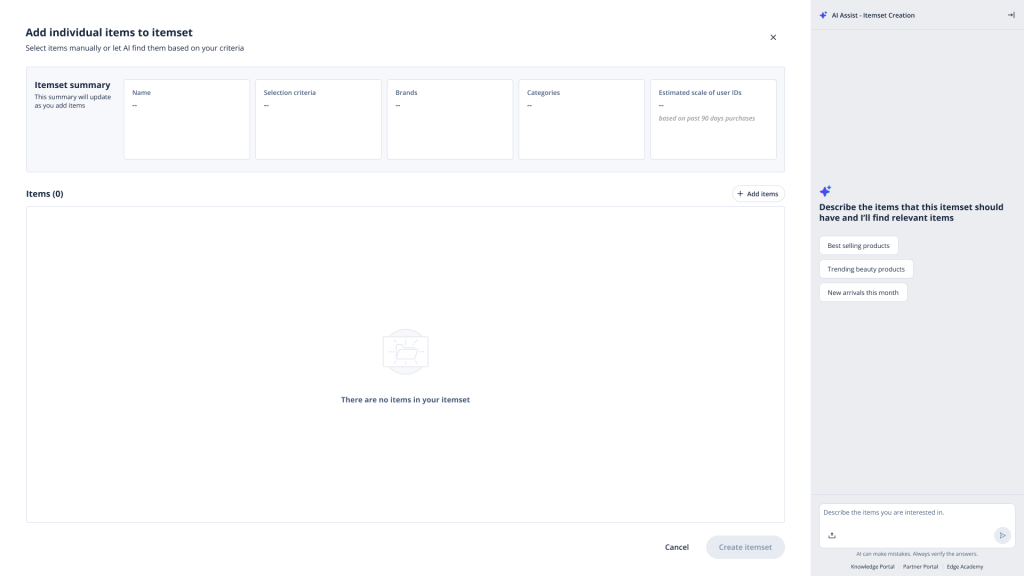
The prototype resonated strongly with traders.
Rather than simply trying the feature once, users immediately began testing it against their own real-world use cases and requesting additional capabilities.
This behaviour became one of the clearest signals that the workflow was solving a genuine problem rather than showcasing a new technology.
The project also helped establish foundational patterns for introducing AI into enterprise workflows across The Trade Desk platform.
Reflection
The most important lesson from this project was that AI itself was never the innovation.
The real innovation was recognising that users thought in intent rather than products.
The evolution of the workflow reflected that insight:
Manual Product Selection → Attribute-Based Definition → Intent-Based Creation
Each iteration moved users further away from implementation details and closer to the business outcomes they were trying to achieve.
AI simply became the most natural interface for expressing that intent.
 Frank Chen
Leave a comment