
Designing for global markets · Crafting interactions
Championing international design considerations.
I led the development of a practical design playbook for global markets. The playbook’s recommendations went on to influence our parent company’s design system.
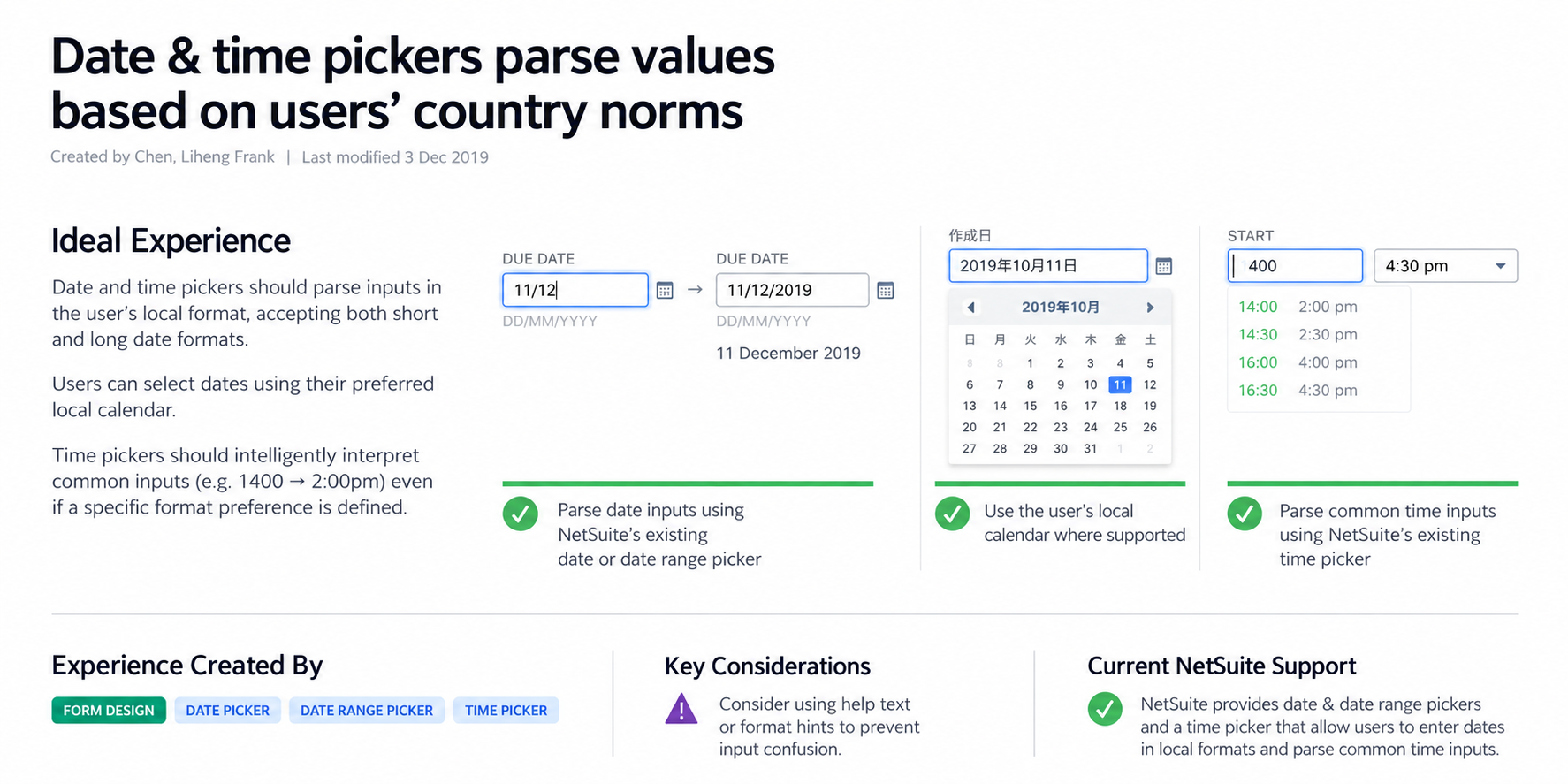
The challenge
Bringing awareness to international design considerations.
As Oracle NetSuite expanded aggressively into global markets, I saw a recurring gap across product teams: “global ready” was often understood as a translation problem rather than a product design problem.
Many country-specific assumptions were hardcoded into product decisions and components—from date and time formats to addresses and other regional conventions. This extended to Oracle’s shared design system, where some components could not accommodate the needs of different markets.
For international product teams, this meant shared components often couldn’t be adopted as designed. Teams resorted to modifying or rebuilding them locally, creating inconsistency and additional technical debt.
I proposed creating lightweight guidelines that product teams could easily reference during design and development, making internationalization part of the product development process rather than an afterthought.
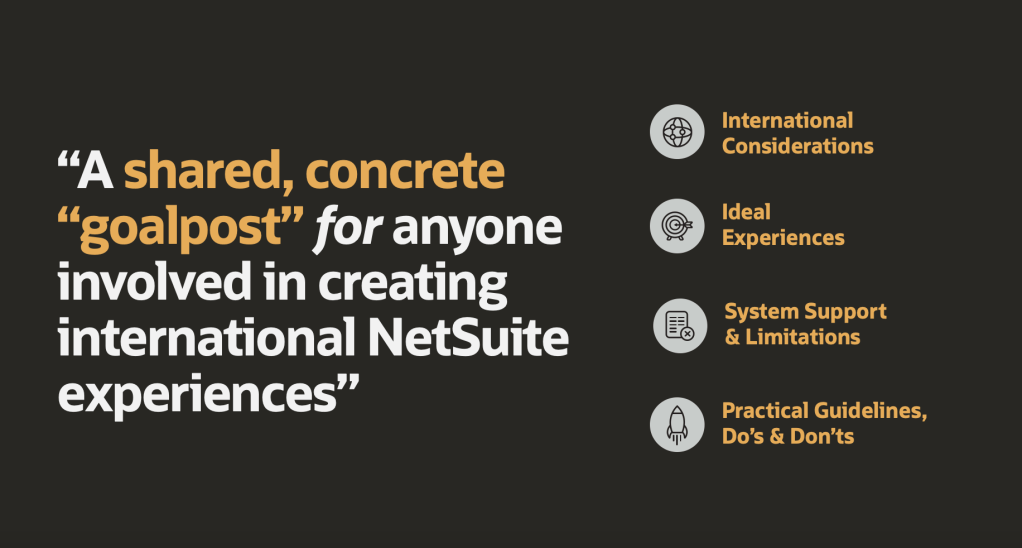
My role
As UX Manager (Japan & APAC), I initiated and led this effort alongside my day-to-day product responsibilities, coordinating contributions across our international UX teams from inception through launch and adoption.
Contribution 01
Defining success around adoption.
From the outset, I emphasized that success wasn’t the creation of the guidelines—it was whether product teams actually used them in their daily work.
To create something that would stick, I needed to understand how designers and developers currently found guidance and made design decisions. Internal interviews across product teams revealed three important behaviours:
People didn’t want more documentation – designers and developers had little time or appetite for lengthy documentation, preferring succinct guidance supported by clear visual examples.
There was no single source of truth – guidance was scattered across numerous internal resources, some incomplete or even contradictory.
Existing products had become the de facto reference – developers frequently reverse-engineered existing implementations to determine which patterns to follow. This meant problematic patterns could easily be copied and proliferate across the product.
These findings shaped a key principle for the initiative: if product teams were to adopt the guidelines, they needed to be easier to find, understand and apply than the alternatives.
Contribution 02
Driving design execution.
I translated this principle into the design of the playbook and drove its execution from content creation through launch and adoption:
Setting the design approach – I established a common template built around progressive disclosure: a high-level checklist surfaced what teams needed to consider, while drill-down pages provided implementation guidance only when needed. I prioritized succinct content and visual examples over lengthy explanations.
Authoring and maintaining quality – I authored the majority of the guidelines myself. Where topics were delegated to designers from other international teams, I reviewed their work to ensure the guidance remained consistent in structure, quality and intent.
Driving adoption – I planned the rollout alongside the playbook itself, including a series of brown bags to build awareness across product teams. I led most sessions directly and coordinated designers across regions to ensure we could reach teams in different time zones.
Shipping pragmatically – Rather than waiting for the playbook to be comprehensive, I pushed for an early launch followed by regular updates—allowing us to start influencing product decisions while continuing to build out the resource.
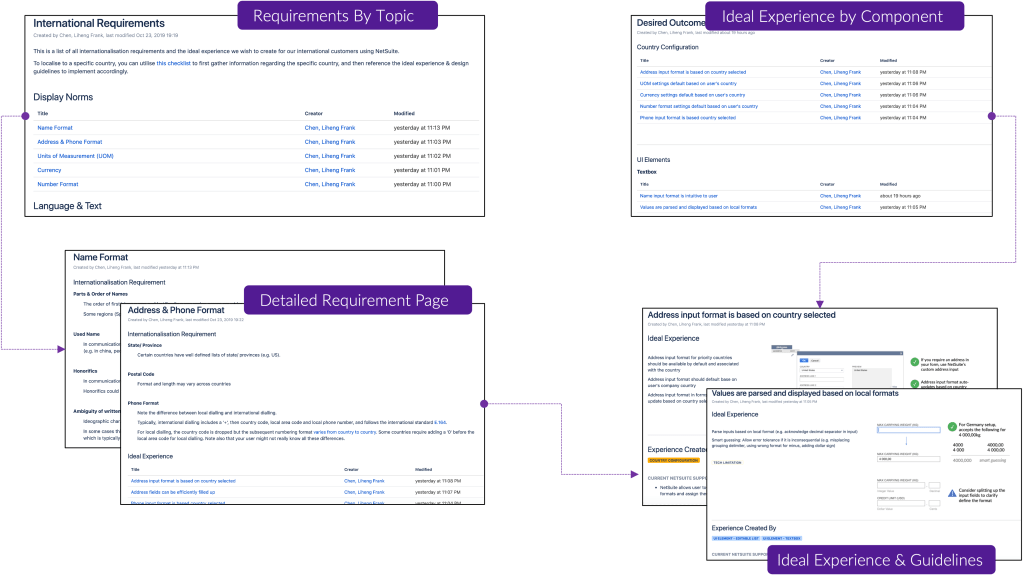
Outcome
Greater awareness, better shared components.
The playbook was adopted by five product teams across APAC, LATAM, and EMEA, becoming a reference within their own design and development processes. Our brown bags reached around 30 product practitioners, while feedback and contributions helped grow the guidelines to 40 topics.
The impact eventually extended beyond NetSuite. We used the guidelines to demonstrate recurring internationalization gaps in Oracle’s shared design system and advocate for change. This influenced Oracle’s design systems team to update common components to better support international requirements, allowing the work to benefit product teams well beyond those directly using our guidelines.

