
UX Manager (Japan & APAC), Oracle NetSuite
The ask
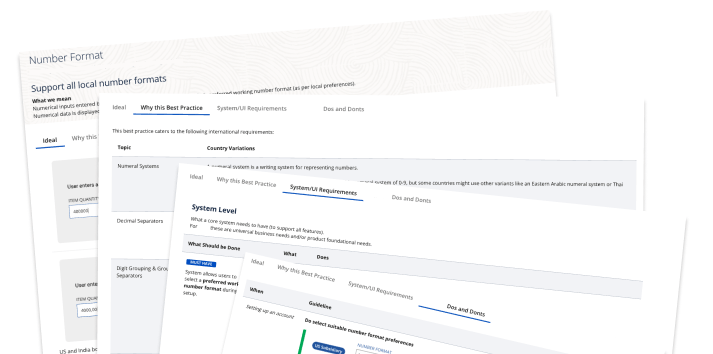
Create guides that instruct product teams how to create features that are global ready – i.e. suitable for use by customers of different countries, languages and preferences.
Why
Across product teams, we noticed a general lack of awareness what it meant for a product to be global ready:
- Many assumed it meant translating interfaces into different languages
- Others assumed preferences specific to their country were universal, and hardcoded such preferences into the products they created
Research
We first conducted internal interviews with designers and developers across different product teams to understand how they prepared for design/development tasks, and what they did when facing design challenges.
What we learnt
- Developers (and designers) did not like to read documentation, and neither did they have time to wade through tons of materials – they liked guides that were succinct and had many illustrations
- There was no single source of truth in the company with regard to design patterns and guidelines – there were many guideline pages, but most were incomplete and some even conflicted with each other
- Developers often referenced existing implementations and “reverse-engineered” the underlying design pattern to follow – this meant wrong design patterns could establish a strangle hold and keep proliferating if no one challenged them
Our design hypothesis
- Our guides needed to be succinct – we wanted to use progressive disclosure to structure the content: only show what must/must not be done, and only if the user is interested do we show more information/background
- We needed more pictures and less words
- We needed launch activities – something to make product teams aware of the playbook
The design
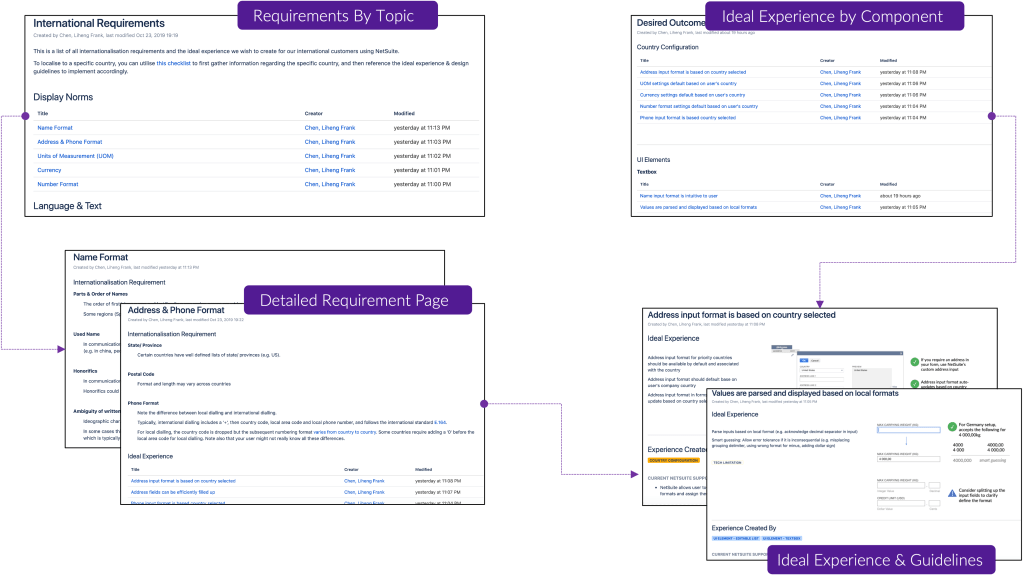
- We sited the playbook on Confluence as it was the platform most commonly used by both developers and designers (our target users)
- Users were brought to a high level checklist of global ready topics (e.g. date/time formats, characters, currency) with a brief description of the expected experience
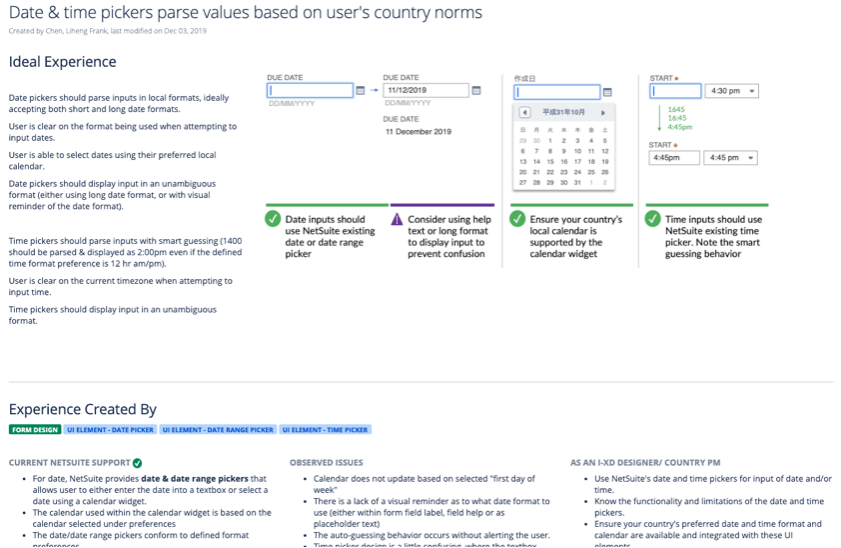
- Users could drill down into a particular topic to find out how the system has been designed to cater to the topic and relevant do’s and don’ts
- The illustrations within the pages helped to summarise the page’s content
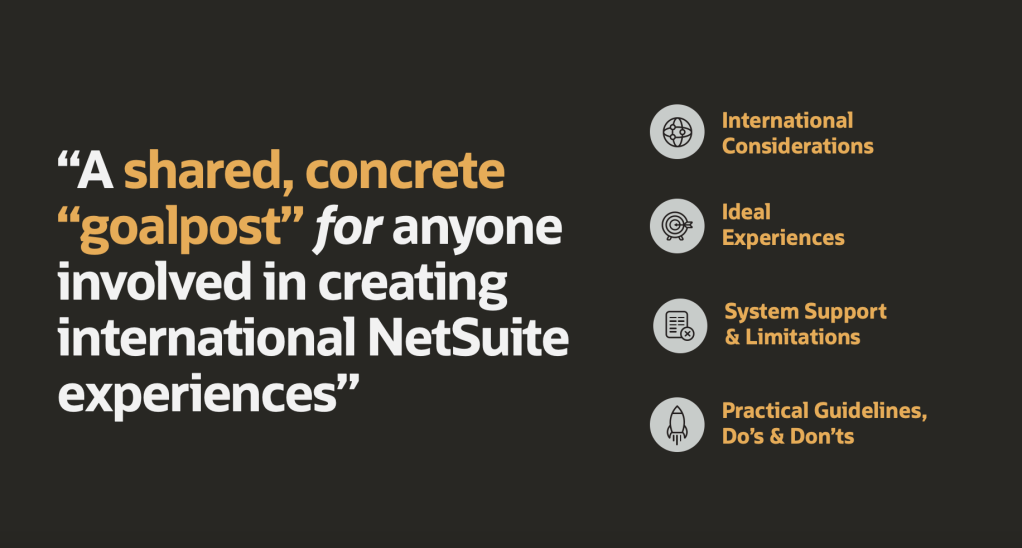
- Along with the launch of the playbook, we also scheduled a series of brown bag sessions to build interest and reach out to more product teams
- We also opted a quick launch followed up regular updates to the pages in order to manage stakeholder expectations whilst striving for excellence
The Results
The playbook was adopted by up to 5 product teams across APAC, LATAM, and EMEA, and became a reference within their own design and development processes. Up to 30 product people attended our brown bag sessions, generating feedback that helped us grow the content to 40 topics.
Most significantly, the work caught the attention of our parent company Oracle — we used the playbook to influence their design system team to update common components to meet international requirements, extending the impact well beyond Oracle NetSuite.
 Frank Chen
Leave a comment