It’s a testament to how pervasive AI has become that it now features regularly in dinner conversations with my family. These conversations have made me realise just how different our mental models of AI are, and how they subsequently shape the ways we use it.
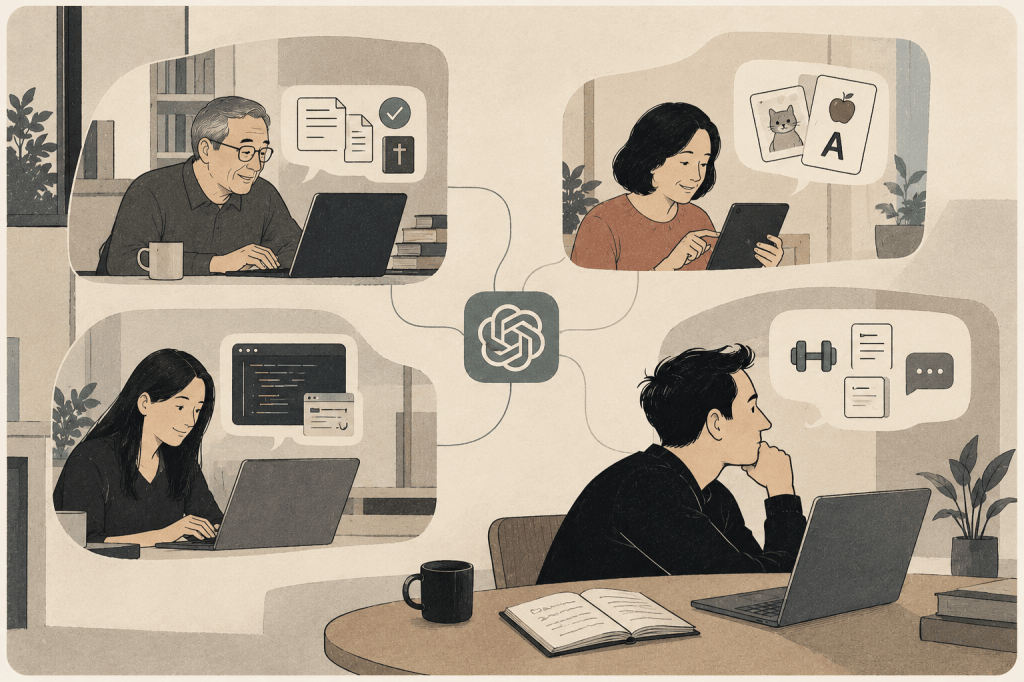
Take my dad for example, who has annoyed all of us by using AI to generate franken-images of everyone that he then uses in family e-vites. He also uses AI extensively for research and co-writing during his daily Bible reading and swears by the accuracy of his writing, having developed a rigorous fact-checking process: getting ChatGPT to write up his thoughts, then running them through Claude before publishing them on Facebook.
My mom on the other hand, uses ChatGPT without logging in — citing a fear of having her conversations and data potentially stolen by big tech, bless her soul. She does however, love the ability to instruct AI to make simple image edits and create personalised alphabet cards to interact with her granddaughter.
My sister loves the ability to vibe code simple applications that have saved her considerable time with family administration work but prefers to still search for food recommendations and general information. She feels recommendations from AI are pretty crappy and worries about the accuracy of the information she gets.
Then there’s me. Well.. I’m embarrassed to say my first instinct is to consult ChatGPT. Be it for fitness advice, organizing my thoughts, improving my resume and preparing for interviews — ChatGPT has had varying levels of input. But such usage has also given me a more nuanced assessment of its capabilities — I review and sometimes rewrite text that I ask it to churn out, and I would verify information I ask from it if accuracy is important. What I really like about ChatGPT is how it acts as a thinking partner and helps me sort through my own thoughts.
Constructing our own version of AI
It’s essentially the same technology. Yet, we’ve quickly managed to find markedly different things to love about AI, and different reasons to be wary of it. In a sense, we’ve each constructed our own version of AI, shaped by our hopes and fears.
I suspect part of this comes down to just how open-ended ChatGPT and other generative AI tools are. Unlike traditional software, where functions and workflows are relatively well-defined, the possibilities with AI aren’t always immediately obvious. Thus, we approach these tools with our own needs and preconceptions, often influenced by what we’ve seen or heard others do. These initial mental models crucially shape what we even bother trying.
Through trial and error, we gradually refine these mental models. A surprisingly good response might encourage us to explore further, while a disappointing one might put us off an entire category of uses. And because we tend to seek experiences that confirm what we already believe, our initial assumptions may become increasingly self-reinforcing.
Implications for enterprise AI design
All this makes me think that designers working on AI experiences in enterprise applications will likely need to first contend with the divergent mental models that users bring with them.
The same AI feature might face very different barriers to adoption depending on who’s using it. Someone who has repeatedly encountered inaccurate AI responses might be reluctant to trust an AI-powered analytics feature. Someone concerned about privacy might hesitate to share information with an AI assistant, even within a secure enterprise environment. Someone who thinks AI only works with very specific prompts might never venture beyond the examples provided.
These aren’t necessarily problems that can be solved by making an interface more intuitive. They may require different kinds of interventions — demonstrating accuracy, communicating data safeguards, making limitations visible, or encouraging users to experiment beyond their usual ways of interacting with AI.
Exciting times for UX designers in this field indeed.


Leave a Reply