
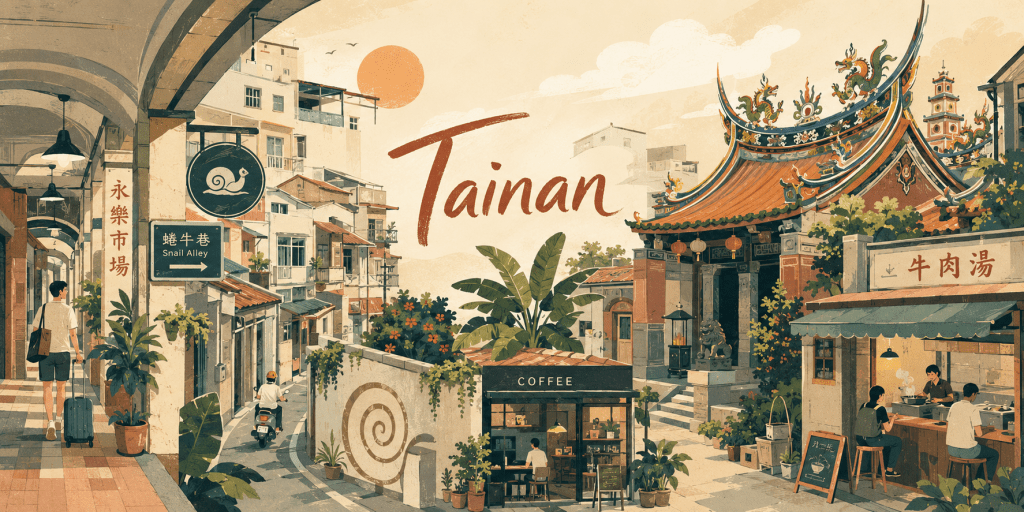
I didn’t know very much about Tainan before I went.
Unlike most trips where I’d spend weeks poring over maps, restaurant lists and itineraries, this one was surprisingly unplanned. The recommendation came from people whose taste I trusted, and somehow that was enough.
They all seemed to describe the same feeling rather than the same attractions.
- “Tainan is worth going.”
- “The alleyways are fascinating.”
- “The cafés and bars are wonderful.”
- “It feels… slower. Like a city that’s somehow been left behind by time.”
That was enough to pique my curiosity.
Armed with only a handful of bookmarked cafés, cocktail bars and neighbourhoods, I planned a short two-day, three-night stay. The point was to experience the vibe, rather than see the top hits.
Stepping out of the train station, Tainan immediately felt older than Taipei.
Not neglected, but settled. Buildings rarely rose beyond two or three storeys. Their facades carried the soft greys, faded paint and rust-coloured stains that only decades of weather can produce. Nothing seemed eager to reinvent itself.
Then there was the pace.
Traffic lights lingered longer than I expected. There was a curious pause between one direction stopping and another beginning, and yet nobody seemed bothered. People simply waited.
Then there was the walking infrastructure.
Instead of broad sidewalks, I found myself weaving beneath continuous rows of sheltered arcades. Every building seemed to contribute a small section, creating an almost uninterrupted path protected from both sun and rain. It wasn’t particularly smooth though – the floor constantly shifted. A step here. A ramp there. Different tiles. Different levels. Pulling luggage was noticeably awkward.
Then came the alleyways.
They twisted gently, almost lazily, refusing to reveal what lay ahead. The famous Snail Alley felt like a perfect metaphor for Tainan itself. Slightly winding. Slightly disorientating. Never frustrating. Every corner invited another.
The neighbourhoods were equally surprising.
A modern minimalist coffee shop might sit beside grungy, busy local establishment selling “warm-body” beef soup. Next to that, a family home. Across the street, a mechanic. A few turns later, a beautifully restored cocktail bar hidden inside what looked like an ordinary old building. Behind that, an ornate temple with decades of history.
Nothing seemed arranged. Yet nothing seemed out of place.
I found myself thinking about that long after I had left Tainan.
None of the individual observations felt particularly remarkable on their own. Older buildings. Narrow streets. Sheltered walkways. Mixed neighbourhoods.
Yet together, they created a city that felt quite different from many others I’d visited.
It wasn’t immediately obvious why, and the designer in me couldn’t quite let it go.
Journey over destination
When I thought back on the parts of Tainan I enjoyed most, very few of them were destinations. They were the moments in between.
The sheltered arcades drew me closer to the life of the street. The winding alleyways constantly suggested there might be something interesting just beyond the next turn. A tiny café tucked between a mechanic and a family home made me curious enough to take another detour.
Walking no longer felt like the cost of reaching somewhere but became the experience itself. The city quietly rewarded curiosity – every unexpected turn paid off just often enough that I kept taking another one.
Experience over efficiency
Objectively, many parts of Tainan felt less efficient.
The walkways changed levels constantly. Traffic lights seemed to take forever. The streets weren’t laid out in neat grids. None of it helped me move faster. Yet I began to wonder if that wasn’t the point.
Because I moved more slowly, I noticed more. I overheard conversations drifting from people queueing for yet another bubble tea. I peeked into people’s houses and witnessed tense family confrontations at the dining table. I noticed the weathered textures of the ornate temple carvings.
The slower pace allowed me to experience the city in a richer way, and in doing so, made me construct a more durable mental map of it.
Rather than navigate via predictable streets and lanes, I encoded landmarks. The temple behind the alley. The butcher beside the coffee shop. Each became a small anchor in my memory, and in doing so the city became familiar remarkably quickly.
Everyday convenience over industrial optmization
One assumption I hadn’t questioned until then was zoning: Residential districts. Commercial districts. Entertainment districts.
Tainan blurred almost all of those boundaries.
Coffee shops. Mechanics. Homes. Bakeries. Temples. Cocktail bars. Everything existed within walking distance of everything else.
It looked haphazardly planned but it worked for everyday living. If anything, it felt like the neighbourhood was designed around the rhythm of daily life instead of categories on a planning document.
Of course, there are good reasons cities adopt zoning. Concentrating commercial districts creates economic density and business convenience. Standardisation makes planning and infrastructure easier.
Tainan isn’t a blueprint that every city should copy, but it reminded me that every design decision optimises for something—and inevitably gives something else up.
The city shapes the behavior
Looking back, I realised how Tainan, with all its twisty alleyways, sheltered arcades, and haphazard assortment of facades on every street, had quietly shaped my behavior.
I walked more slowly. I noticed more. I found myself taking one more turn simply because it looked interesting. I stopped worrying about whether I was “getting somewhere”. I became comfortable getting a little lost.
None of those behaviours were instructed. They simply emerged from the environment around me.
Of course, the environment wasn’t the whole story. Mindset mattered too.
Had I approached Tainan with a checklist of must-see attractions and famous eateries, I suspect I would have experienced a very different city. I might have been frustrated by the slower pace, puzzled when Google Maps claimed somewhere was open when it clearly wasn’t, or impatient with the winding streets.
Instead, I had arrived hoping to experience the city rather than optimize for it. That openness allowed me to appreciate what Tainan quietly encouraged.
With the right mindset, the city didn’t ask me to behave differently. It simply made those behaviours feel natural and worthwhile.
What good design entails
That idea stayed with me long after I got home.
It made me think about conversations I had with non-design senior stakeholders. Whenever we talked about “good design”, the conversation almost always drifted towards efficiency. Fewer clicks. Removing friction. Simplifying complexity.
I believe those things matter a lot. But now I wonder if that’s only half the job.
Perhaps good design isn’t simply about creating the shortest path between intention and outcome. Perhaps it’s about shaping environments that encourage the behaviours we hope to see.
Cities do it. Products do it. Homes do it. Even the routines and schedules we create for ourselves do it. Every environment nudges us, whether intentionally or not. The question isn’t whether design changes behaviour. It’s whether we’ve thought carefully about the behaviours we’re encouraging.
That thought also made me reconsider the distinction between systems designed for machines and systems designed for people.
When we design APIs, efficiency is almost always the right answer. Machines don’t need reassurance. They don’t need landmarks. They don’t need to gradually build confidence.
Humans do.
A user interface has a different responsibility. It isn’t simply about execution efficiency. It’s also about orientation, learning and, eventually, mastery.
Cities work the same way – the goal isn’t simply to move people through them as quickly as possible. It’s to create places where people can orient themselves, discover, connect and ultimately feel at home.
Before visiting, people described Tainan as “slower.” Looking back, I don’t think that was quite right.
Tainan simply chose to optimise for different things. It optimised for wandering over throughput. For discovery over directness. For neighbourhoods over districts. For understanding over speed.
Perhaps that’s why, even months later, I still find myself thinking about it.


Leave a Reply